In Search of Losses/Time

While writing up the post about the 76ers’ run of success, something odd occurred to me. The record for most losses in a season is 73, set by the 1972-73 76ers. As you might notice, that means that their loss count matches the a year of their particularly putrid season. Per Basketball Reference, only one other team has done this: the expansion 1961-62 Chicago Packers. (Can you imagine having a team called the Packers in Chicago now? It’d be weird for a name to be shared by a city’s team and a rival of another team in that city, but I suppose that’s how it was for Brooklyn Dodgers fans in the 1940s and 1950s, and maybe for St. Louis fans when the NFC West heats up.)

That Packers team went 18-62, though BR says they were expected to finish at 21-59. The only player whose name I recognize is the recently deceased Walt Bellamy, who was a rookie that year. They only hung on in Chicago for one more year before moving to Baltimore. They also put up 111 points a game and gave up 119, because early 1960s basketball was pretty damned wild.

So, this is an exclusive club, if a little arbitrary–there are 4 other teams from the 20th century who lost more games than the corresponding year, and obviously every team from the 21st has lost more than the year. Still, it’s a set of 2 truly terrible teams, but the next member is presumably going to be one of the very best teams in the league in the next five years or so. The benchmark will only get more and more attainable, so club membership will rapidly devalue. Regardless, I can’t see the members of those two teams popping champagne like the 1972 Dolphins when the last team hits 14 losses this year–though it’d be hilarious if they did.

Lining Up Behind the 76ers

Going into the year, there was an honest discussion as to whether the 76ers would post the worst record in NBA history, topping their own record of 9-73 from 1972-73. (See here and here.) After 3 games…well, let’s just say that discussion’s been tabled. 3 wins in a month makes it hard to take a run at 8-74, especially when two of them are against the very best teams in the league. It’s going to take serious commitment to winning the Ender Game* for them to not scrape out another 6+ wins playing against the Raptors, Celtics, et al.

Still, I would say that the story is not that the Sixers aren’t historically terrible—it’s that they’re quite terrible and managed to beat three teams in four nights, two of which were expected to be very good.

Just how unexpected was this? There are obviously a few ways of looking at this. I could look to AccuScore, probably the most notable sports prediction engine out there, though I can’t find their early season NBA picks lying around anywhere. However, everything is more fun when there’s money involved, so we’re going to do this in terms of gambling. Specifically, if you bet the Sixers to beat the Heat straight up, then bet all your winnings on them against the Wizards, and did it again against the Bulls, how would you have done? Moreover, how often does a streak that’s this improbable occur?

Well, according to Odds Portal, if you’d started with $100 and kept reinvesting, you’d have a stake of $13,206.26, for a profit of $13,106.26. If you prefer a percentage return, since we picked $100 you can see this pretty easily—131x, or 13100%. This isn’t unheard of in sports gambling—someone made $375K on two $250 bets on the Cardinals in 2011—but it’s still quite impressive, especially given that these are single game bets rather than bets on a team winning the title.

How impressive is it? To answer that, I scraped NBA money line data from 2007-08 through 2011-12 from Sports Book Reviews, and while I can’t evaluate the exact accuracy of their lines, I figure it’s probably good enough. (They seem a little extreme, but I don’t bet enough basketball to say for sure.) I looked at every three game winning streak in that dataset, counting longer streaks multiple times, e.g. a five game winning streak is three overlapping three game streaks. (Playoffs and multiseason streaks are also included, though neither turned out to be relevant.) For each of those streaks, I calculated how much a prescient (read: lucky) fellow might have made betting $100 on the first game and entirely reinvesting.

(Quick sidenote: this is a fun exercise, but I’ll acknowledge it’s far from perfect. On a practical level, the data aren’t that trustworthy and the assumption that gambling lines proxy for probability estimates is shaky. More troublingly, on a theoretical level we would expect that the lines for the later games in a given streak shift some with a team’s wins in the first game(s). I don’t know enough to guess how much a given set of lines will jump around, but I suspect that this method overestimates the ex ante probability that a streak like this would occur. Also, if we guess that lines bounce around more in the early season, the odds on the Wizards and Bulls games probably dropped quite a bit, further underestimating how rare this streak is.)

Anyhow, as it turns out, only one team has had a three game streak that was as unlikely as these Sixers’ from a Vegas perspective. The post-lockout Wizards had a streak in April 2012 that is in some senses similar to the current Sixers’ streak. They were 14-46 and, with only six games to go, would presumably tank the shit out of the rest of the season for a shot at Anthony Davis. Instead, though, they beat the league-best Bulls on the road (at +675), Milwaukee at home (at +330), and followed it up by beating the eventual champion Heat in Miami (at +450). Riding them for those three games would have made you a profit of $18,228.75, which is just obscene—it’s an extra $5K (or 5000%) beyond the Sixers. As it turns out, they’d close out the season with three more wins, all as favorites, against two tanking teams and the Heat, who were presumably resting starters by then. If you’d kept piling on, those six games would have gotten you almost 47 grand…though it might have also merited an intervention.

There are only two other teams in the same ballpark as these Sixers and Wizards. The December 2007 Trailblazers picked up a profit of $10,956 and were buoyed by a win in Utah at +1200—apparently they had only won once previously on the road and were missing LaMarcus Aldridge. They were moderate underdogs the other two games (+170 and +215), but it was driven by that one game. The only other team above $10K (or even $8K) is the March 2012 Cavaliers at $10,508, who got there by winning at Denver and Oklahoma City.

So in nearly 5 years of data, we have one bigger streak and two that are in the neighborhood. As I said earlier, I think the Sixers’ streak is a little more unexpected than this method gives it credit for (even relative to other streaks), but by this method we figure that this is a once in five years occurrence, even if seems much odder than that right now.

All this said: even if I take the supposedly rational perspective that weird shit happens in small samples, it still doesn’t make me feel better about the Bulls’ blowing that lead last night, though. At least Rose is back: he’ll probably be fodder for posts later down the line.

*Andrew Wiggins is the presumptive #1 pick in the next draft. Andrew Wiggin is the real name of the protagonist of Ender’s Game. We can make this happen, people.
Justice, Unobstructed

There’s already been a large amount of figurative ink spillage about this, but I wanted to throw in a couple of thoughts. The first is that I’m of the opinion the call is unimpeachably accurate, though one can probably make a reasonable argument that a no-call would also have been correct. The rest of the thoughts are more about the reactions to the call.

An awful lot of people have been criticizing Saltalamacchia for throwing to third. While it (obviously) didn’t turn out well, I don’t think it’s quite as unambiguous as others do. Craig was safe by a pretty small margin, and if Salty had had a bit of a quicker release I think he could have had him. Middlebrooks probably should have caught it, also. Rob Neyer has a more thorough breakdown of all of this.

While the process was not perfect, though, I’m fairly certain that if Craig had been out at third or Middlebrooks had caught it, nobody would have said anything about the throw. I know that we can’t (and shouldn’t) ignore results entirely, because that’s why they play the games, but I’m pretty sure nobody would have ever said anything about that throw if Middlebrooks makes the catch, and that’s a shame for Saltalamacchia, who’s the goat in this scenario.

Also in the process/results bucket: from a baseball standpoint, Molina should have clobbered Saltalamacchia, which I haven’t seen anyone point out. (I say from a baseball standpoint because I can see broader philosophical objections to home plate collisions, even if they’re legal.) Sliding, he’s guaranteed to be out, and there’s a slight possibility that Craig is out and the inning is over. (There’s also a veeeeeeeeery slight possibility that the ball gets thrown away and Craig scores on obstruction. Baseball’s weird.) If he does the full charge into Salty, he scores with a dropped ball, and either way he definitely prevents a throw to third, functionally guaranteeing that Craig gets in safe. He got really lucky, but it’s still a baserunning error.

Finally, a bit of philosophical musing. There’s a healthy undercurrent of people saying “let the players decide the game, not the umps,” though less in this case than in other games. Not to put too fine a point on it, but that’s a crock of shit. For one, not making a call has just as much of an effect as making a call. For another, that philosophy rewards teams for going a little over the line with the knowledge that the penalty can’t match the crime, which usually degrades the quality of play and is unfair to the rule-abiding team. This leads to things like the holding on the Ravens intentional safety in the Super Bowl, endless moving screens in basketball, and defenders’ mugging forwards in the box on restarts in soccer because they know the ref won’t call the PK. It’s unsightly and unfair, and we shouldn’t encourage it.

The only time I can think of that the rules should maybe be called differently at crucial times is when the rules are intended to govern a part of the game that’s not really related to who wins and loses. The best example of this is the Pine Tar Game, where the rule was so clearly unrelated to Brett’s home run that it was moronic to alter a game outcome because of it. Other examples are things like time wasting and decorum calls in tennis (though those are hazier), the Jim Schwartz rule, and potentially broader safety rules like the pushing penalty in last week’s Pats-Jets game. If there’s no competitive advantage derived, then maybe don’t call the foul.

All told, it’s pretty hard to say that the Red Sox didn’t derive a competitive advantage, so I’m damn glad Joyce and DeMuth made the call. Maybe the NBA refs can take a hint.

Two Step Forwards, Two Steps Back

Reading about Reggie Wayne’s injury, I was moved to look at his page on Pro Football Reference, and noticed something funny: he has four carries lifetime, for a net rushing yardage of 0. (His carries are a loss of 4 in 2004, gain of 4 in 2007, a loss of 5 last year, and a gain of 5 this year in Week 3.) This led me to wonder: who’s the player in the NFL history with the most carries with exactly 0 yards gained? (Look at the list over at PFR.)

The answer, coincidentally, is Wayne’s old teammate Jim Sorgi, best remembered as the guy who would play occasionally late in the season when Peyton Manning’s Colts had locked in their playoff seed. His numbers (including kneeldowns and sacks) give him a pretty hefty 31 carries over his 16 games played. Somewhat poignantly, his last ever game, his first carry went for 12 yards, and he had four subsequent 1 yard kneeldowns to get to exactly 0.

Number two is Tony Bova, who played end and back before you needed modifiers with those positions for a few teams in the 1940s and clocked 21 carries for no net gain. Two other things make Tony a historical outlier: he played for two scab teams created from the flotsam of various ailing franchises, and he was blind in one eye (per Wiki), joining Jim Abbott, Pete Gray, Lance Armstrong, and Zach Hodskins on the list of notable athletes missing one body part that usually comes in pairs.

Skipping a few spots, tied for sixth all time is active leader Shane Lechler, with 6, though checking his game log suggests there might be some irregularities with how punter fumbles are counted. Regardless, given his status as one of the more accomplished specialists currently playing, it’s sort of fitting that he’d have a weird distinction to his name.

It turns out Wayne is tied for ninth and is (along with Dez Bryant) one of the two active players with four. Bryant, however, appears to actually get carries (four in 3+ years), so I can’t imagine he’ll stay on this list very long.

This is a pretty silly topic, and is in the same vein as everyone’s favorite pieces of trivia about Stan Musial, namely that he had the same number of hits at home on the road. It does raise at least one interesting question to me: how does one come up with a theoretical model to handle this? What odds should I get if I wanted to bet that Bryant (or Wayne) finishes his career with exactly 0 rushing yards? It seems like a pretty extreme form of random walk, but given the number of variables involved I don’t know how to rigorously model it. Perhaps something for a stochastic processes class. Ideas, anyone?

Notes on Long Games, Part I

Game 1 of the ALCS was one of those games that make baseball (and all sports, really) so great. It was an immensely important game, a near no-hitter (which would have been the first combined no-hitter in postseason history), and a 1-0 game, keeping the tension up for all nine innings. There’s something I’ve always found charming and pure about 1-0 games (whether in soccer, baseball, or hockey); they tend toward the intense, fluid, and (usually) quick.

Game 1, however, was anything but quick, lasting four minutes shy of four hours. It’s a nationally televised game, the Red Sox have a rep for playing slowly, and there were a hefty number of pitching changes. Still, it’s a ridiculous length of time for a 1-0 game, especially a one hitter.

As it turns out, that was the longest 9 inning 1-0 game on record by a margin of 36 minutes, or 15%, which is an astonishingly large leap. (Retrosheet has confirmed this.) I was curious about the prior record holder, so I did some digging, the results of which below. (All info comes from Retrosheet or Baseball Reference, more about which at the bottom of the post.)

There’s now a tie for #2 on the list; one of those games is a 3:20 1997 game between the Brewers and A’s. It’s a bit easier to see why this game lasted so long: there were a combined 341 pitches thrown, 19 more than 2013 ALCS Game 1. (14 walks were issued and 22 runners were left on base, so I imagine it was a pretty ugly game.) A writeup for the game says it was the longest 9 inning 1-0 game in history.

The other 3:20 game? There were only 270 pitches thrown, but it was in the postseason, so that probably accounts for some of it. Either way, it’s maybe my favorite game I’ve ever watched. Yeah, it’s Game 4 of the 2005 World Series. Unsurprisingly, the record was not the lede in any of the recaps I read. (One cause of the length might be things like Carl Everett’s taking about 75 seconds from the time of the previous out to see his first and only pitch (see 1:57:48 of the video). Guess he was moving like a dinosaur.)

One further note: Retrosheet actually lists two 1-0, 9 inning games as having lengths longer than 3:20 before this week. The first was the game between the Phillies and Cubs on July 19, 1949 listed at 3:34. The game looked otherwise entirely ordinary, and in fact, digging through the NYT archives finds a time of game of 1:54. If I had to guess, 1:54 became 5:14 became 214 minutes. The other game—the second of a doubleheader between the Phillies and Brooklyn Robins in 1917, also has the wrong time listed per the NYT archive (note the amusing old-timey recap in the latter link). Here it appears 2:06 became 206. I’ve reached out to Retrosheet and will hopefully have those corrected soon.

Check back in the near future for more on baseball game length.

Doing the Splits with Josh Hamilton

I’m in the course of looking at some splits for active players (mostly day/night splits) and came across something I found interesting.

http://www.baseball-reference.com/play-index/split_stats.cgi?full=1&params=stad%7CDay%7Chamiljo03%7Cbat%7CAB%7C

The link is Josh Hamilton’s statistics during day games by year. (All numbers in this post come from b-r.) The thing I keyed in on is tOPS+, which is his OPS relative to his overall OPS–100 would be equal, and 120, say, would be a 20% increase. Here’s that number in day games over his career, with the number of day plate appearances in parentheses:

36 (85), 73 (172), 108 (96), 59 (145), 49 (143), 112 (169), 101 (182).

Now, that’s a pretty dramatic uptick in the last two years, but this is a player known for his volatility (in more than one sense), and we’re not looking at huge samples. Is there a simple explanation? At first, it seems so:

Rangers outfielder Josh Hamilton walked into the clubhouse wearing contact lenses that made his eye look red on Friday. His hope is that they can cut down in the amount of light and help him see the ball better during the day.

That quote is from ESPN Dallas, dated June 24, 2011.

Is this evidence that those stats aren’t a fluke, or (alternatively) evidence that the red contacts aren’t total quackery?

Of course, it’s not simple. For one, there’s no information I could find suggesting that he actually kept wearing them.* Moreover, some of that difference probably is just randomness, since his BABIP was 100 points higher in night games that year. Relatedly, his SLG was about 300 points higher as well–which is a sign he was making much better contact, though it could just be luck. (I couldn’t find his Line Drive % split by Day/Night, but a higher LD% would account for both SLG and BABIP.) Perhaps most importantly, Hamilton actually played about half his 2011 day games after he got the lenses, and still wound up with that awful split.

Still, the fact remains that his (relative) performance went from really awful to respectable after this. The most obvious reason it evened out, though, is that his nighttime strikeout rate almost doubled (2011: 13.4%, 2012: 25.5%, 2013: 24.2%), while his daytime strikeout rate stayed the same (2011: 28.0%, 2012: 25.4%, 2013: 26.4%).

If you’re a believer in the contacts, you’d say that he’s gotten worse overall, but that overall backsliding was counteracted by his daytime improvement, so his splits normalized. If you’re skeptical, especially since he probably hasn’t been wearing the contacts, you say that there was a lot of luck in that 2011 split and that this is regression to the mean. I’m inclined to go with the latter, not least because it’s much simpler.

However, I’m on the fence as to whether Hamilton actually is a worse hitter during day games. On the one hand, he’s got a season and a half of data and the second worst split among active players with at least 600 day at-bats. On the other hand, there’s a 40 point differential in BABIP that I’m fairly willing to chalk up to luck, and there are major multiplicity concerns when you pull one split for one player out of the vast morass of baseball data. I’m inclined to file this whole thing away as an example of the difficulties of trying to do rigorous data work: sometimes you see an interesting nugget in the data and think you have a great explanation, and then it evaporates when you do a bit more digging. C’est la vie.

*This is a big deal, and probably enough to nullify any conclusions I could draw. I kept going just for the hell of it.

Tim McCarver and Going the Other Way

During the Tigers-Red Sox game last night, Tim McCarver said he thought it was a little odd that the Tigers would bring in lefty Drew Smyly to face David Ortiz while also leaving the shift on, since lefties are more likely to go to the opposite field against a left-handed pitcher. (At the very least, I know he said this last part. Memory is a tricky thing, and I’m now not sure whether he said this about Ortiz or someone else, possibly Alex Avila.) Being Tim McCarver, he didn’t say why this might be true, nor did he cite a source for this information, putting this firmly in the realm of obnoxious hypotheses.

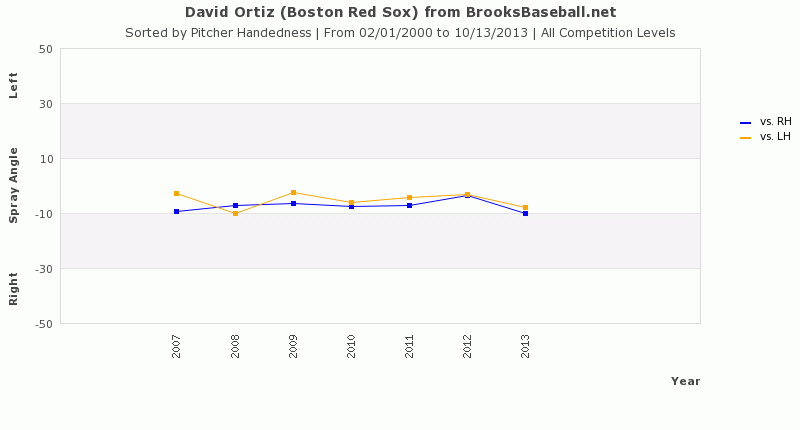
The first question is whether or not this is true. For that, there are these handy aggregated spray charts, courtesy Brooks Baseball.

David Ortiz Aggregated Spray Charts by Pitcher Handedness, 2007–2013

Alex Avila Aggregated Spray Charts by Pitcher Handedness, 2007–2013

Based on these data, I have to say it seems like McCarver’s assertion is true: they are slightly more likely to go to left against a left-handed pitcher. I don’t have enough information to say if the differences are either statistically significant (I’d guess it is, given the number of balls these guys have put into play in the last  5-7 years) or practically significant (I kinda doubt it). Regardless of the answer, though, the fact remains that the appropriate thing to do is to bring in the lefty and shift slightly less drastically, so who knows why McCarver brought this up to begin with. After all, Ortiz hits drastically worse against lefties (his OPS against lefties is 24% smaller than his lifetime rate, via baseball-reference), as does Avila (36%).

There’s also the question of why this might be true, and in fairness to McCarver, there are some pretty plausible mechanisms for what he was saying. One is that a breaking pitch from a left-hander is more likely to be on the outer part of the plate for a left-handed batter than a similar pitch from a right-handed batter, and outside pitches are more likely to get hit the other way. Another is that left-handed batters can’t pick up a pitch as easily against a left-handed pitcher, so they are more likely to make late contact, which is in turn more likely to go to the opposite field. I can’t necessarily confirm either of these mechanisms empirically, though looking at Brooks splits for Avila and Ortiz suggests that the fraction of outside pitches they see against left-handers is about 3 percentage points larger than the fraction against righties.

So, what McCarver said was true (though not terribly helpful), and there are seemingly good reasons for it to be true. I still posted something, though, because this is a great example of something that pisses me off about sports commentators–a tendency to toss out suppositions and not bother with supporting or explaining them. (Another good example of this is Hawk Harrelson.) That tendency, along with their love of throwing out hypotheses that are totally unfalsifiable (McCarver asserting that the pitching coach coming out to the mound is valuable, e.g.), is one of the things I plan to deal with pretty regularly in this space.

(Happy first post, everyone.)